CDL Endorsements in Georgia: Types and Requirements
What are CDL endorsements?
A CDL endorsement is an add-on authorization that lets a licensed commercial driver operate a specialized vehicle or carry a specific type of cargo, such as passengers, a school bus, a tank vehicle, hazardous materials, or multiple trailers. Georgia and federal rules currently recognize six endorsement codes: P, S, H, T, N, and X, and each one has its own requirements a driver must meet before getting it.
A CDL class and an endorsement are not the same thing. Class A covers combination vehicles, like semi-trucks and flatbed trucks. Class B covers single heavy vehicles, like straight trucks and buses. Class C covers smaller vehicles built for 16 or more passengers or vehicles that carry certain hazardous materials.
CDL Endorsement Guide
| Code | Vehicle or cargo | Who typically needs it | Georgia test and CLP status |
|---|---|---|---|
| P | Passenger vehicle built for 16 or more people, including the driver | Transit, church, or charter bus drivers | Knowledge and skills test; can be tested on just a CLP |
| S | School bus | School bus drivers, must also qualify for P | Knowledge and skills test; can be tested on just a CLP |
| H | Placarded hazardous material | Drivers hauling placarded hazmat loads | Knowledge test only; requires a valid CDL; not available on just a CLP; TSA background check and fingerprinting required |
| T | Double or triple trailers | Drivers pulling more than one trailer; Georgia limits T to Class A CDL holders | Knowledge test only; requires a valid CDL; not available on just a CLP |
| N | Tank vehicle carrying liquid or gas, not necessarily hazardous | Drivers hauling qualifying tank loads in Class A or Class B vehicles | Knowledge test only; can be tested on just a CLP, but you can’t carry cargo without a CDL |
| X | Tank vehicle plus hazardous material, combined | Drivers hauling hazmat in a tank vehicle; valid for all CDL Classes/Types (A, B, C) | Knowledge test only; requires a valid CDL; not available on just a CLP; TSA background check required |
How to Add an Endorsement in Georgia
Follow these steps to add an endorsement to a Georgia CDL.
- Get a commercial learner permit (CLP). Georgia requires a CLP before a first CDL and before some license upgrades.
- Check if the endorsement can be tested on a CLP. P, S, and N can be tested while the driver still holds only a CLP. T, H, and X require the driver to already have a full CDL.
- Complete training if it’s required. For a first-time P, S, or H endorsement, drivers must complete entry-level driver training (ELDT) with a registered provider like GDA before the test. N and T do not have their own separate training requirement.
- Wait 14 days. A driver must hold the CLP for at least 14 days before taking the CDL skills test (ELDT training time counts towards the 14 days).
- Clear a TSA background check for H or X. Applicants must undergo a TSA Security Threat Assessment, including fingerprinting. This happens the first time a driver gets the endorsement and again at each renewal, generally every 5 years.
- Pass the required test. P and S need both a knowledge test and a skills test. H, T, N, and X only need a knowledge test.
- Wait for Georgia DDS to issue the endorsement. The state adds the endorsement to the CDL only after the driver passes the test and, for H and X, clears the TSA background check.
Good to know:
- A driver testing for P, S, or N on a CLP can’t carry passengers or cargo during that test.
- X includes hazmat privileges, so drivers adding X should confirm with Georgia DDS whether it counts as a first-time H addition.
Which Endorsement Fits the Job
The right endorsement depends on the vehicle and the cargo, not on job title alone:
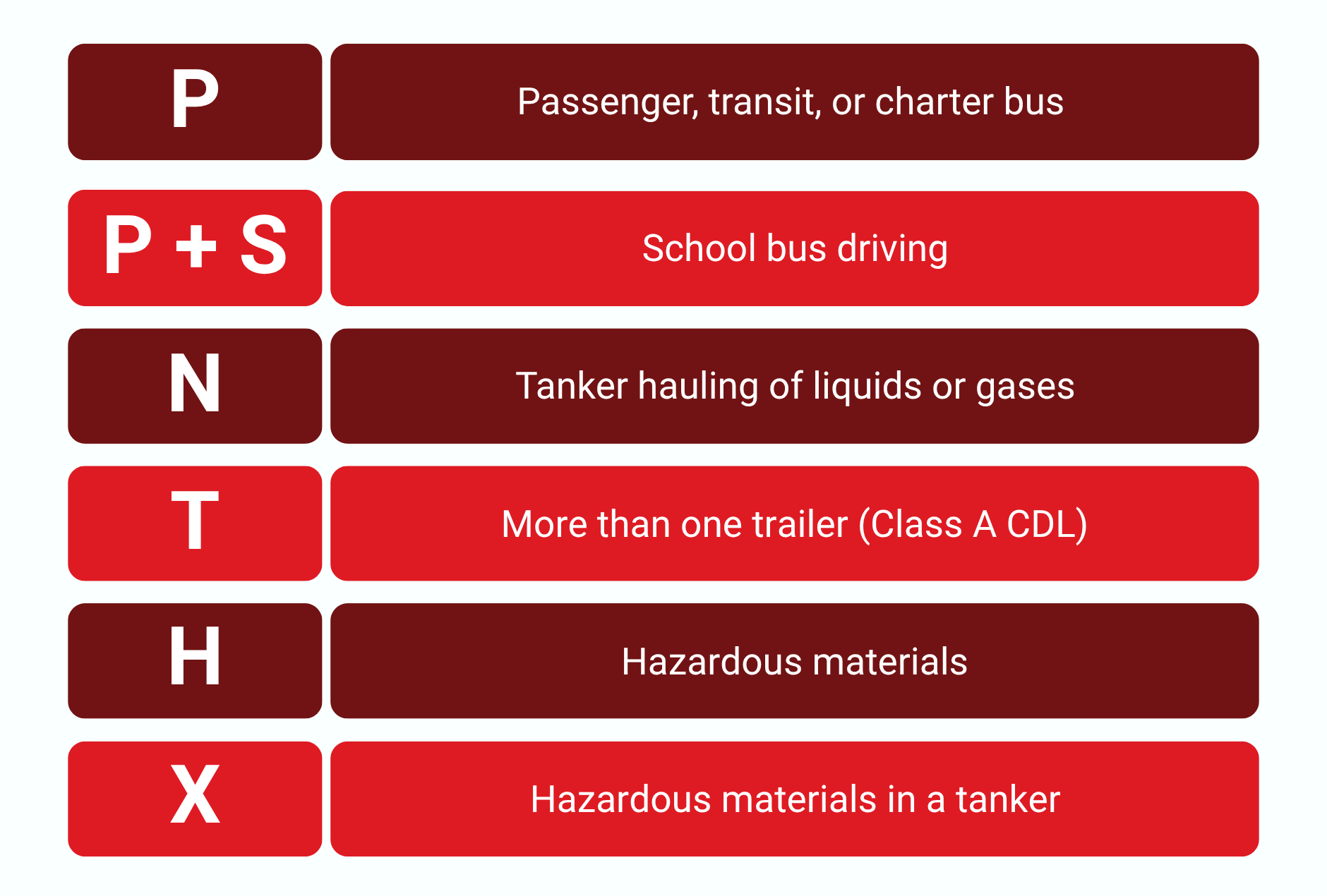
- Passenger, transit, or charter bus work calls for P.
- School bus driving calls for P and S together.
- Tanker hauling of liquids or gases calls for N.
- Pulling more than one trailer calls for T, limited to Class A.
- Hazardous material hauling calls for H.
- Hazardous material in a tank vehicle calls for X.
A lot of careers with specific haul types require drivers to have multiple endorsements. For example, a driver planning a career around fuel, chemical, or bulk-liquid transport often needs both N and H, or the combined X endorsement, depending on whether the load is hazardous. It is always best to check with an employer or a driving school advisor for a full list of endorsements that you would need for your desired career.
GDA Training Options for CDL Endorsements
Georgia Driving Academy prepares students for entry-level driving jobs through Class A CDL training, a program that combines classroom instruction with range and road practice in air brakes, coupling and uncoupling, backing, and local and interstate driving. The program runs 160 hours for the automatic-transmission track or 180 hours for students who also want manual-restriction removal.
Students who want to drive a school bus, motorcoach, or Class B-rated automatic vehicle can complete Class B CDL training, a 70-hour full-time course covering pre-trip inspection, air brakes, backing maneuvers, and CDL road testing.
Georgia Driving Academy also offers a 6-hour hazmat endorsement training course that meets federal ELDT Part 380 requirements. The course covers hazardous-material pre-trip inspection, tanker vehicle operation, cargo inspection, and the properties of the nine FMCSA hazard classes. Finishing the course is required before the state H knowledge test, but the course alone does not place H on a CDL. The TSA background check and the state knowledge test are separate steps that follow. GDA’s team helps students work their way through all of the steps after training is completed.
Georgia Driving Academy has campuses in Conyers, Columbus, and Augusta, and hazmat training is offered at all three. Students interested in a specific campus or an upcoming start date should reach out to the GDA team.
Cost and Time for CDL Endorsements
Program lengths are strongly defined with GDA. Class A CDL training runs 160 to 180 hours, Class B CDL training runs 70 hours, and hazmat endorsement training runs 6 hours.
Total tuition, state testing fees, and TSA fingerprinting fees vary, and they are best confirmed directly with admissions, Georgia DDS, or TSA. State processing time for a knowledge test, a skills test, or a TSA background check also varies by applicant and by DDS office, so training time and state issuance time are not the same clock.
Students who need help paying for training can ask about WIOA funding, Trade Adjustment Assistance, and GI Bill® benefits through tuition assistance. Veterans and eligible family members can review the veterans benefits page for VA-approved programs at the Conyers and Columbus campuses.
Frequently Asked Questions
What is a CDL endorsement?
A CDL endorsement is an added authorization on a commercial driver’s license for a specialized vehicle or cargo type, such as passengers, a school bus, hazardous materials, tank vehicles, or multiple trailers. Georgia and federal rules currently use six codes: P, S, H, T, N, and X.
Do all CDL drivers need endorsements?
No, not every CDL driver needs an endorsement. A driver only needs one if they are looking for work that involves a vehicle or cargo type covered by P, S, H, T, N, or X, such as hauling tanker loads or driving a school bus.
How do drivers get the H endorsement?
Drivers add H by completing hazmat theory training with a registered ELDT provider, like GDA. They then have to pass the state hazmat knowledge test and clear a TSA Security Threat Assessment that includes fingerprinting. All three steps are required, and drivers must have their CDL already.
What is the difference between N and X endorsements?
N authorizes a driver to haul a qualifying tank vehicle, and the cargo does not have to be hazardous. X combines the tank authorization with hazardous materials hauling and requires the same TSA screening as H.
Can a Class B driver add P, S, or N endorsements?
Yes, Georgia lists P and N as valid for Class B, and S pairs with P for school bus driving in a qualifying Class B vehicle.